How to Apply for Copyright Registration in India 2026: Complete Step-by-Step Guide
You Created It. Now Protect It. Here's Why Copyright Registration Can't Wait
Imagine spending months writing a book, composing a song, designing a logo, or building a software product — only to find someone else using it without your permission. Frustrating? Absolutely. Preventable? Yes — with copyright registration.
Yet surprisingly, most creators, entrepreneurs, and businesses in India skip this step entirely. Some assume their work is automatically protected the moment it's created. Others find the process confusing. And many simply don't know where to start.
If you're a writer, artist, photographer, musician, software developer, filmmaker, or business owner in India — this guide will walk you through exactly how to apply for copyright registration in India in , step by step, in plain language.
What is Copyright Registration in India?
Copyright registration in India is the official legal process of recording ownership of an original creation work — such as a book, song, artwork, film, software, or website — with the Copyright Office under the Ministry of Commerce and Industry. It provides legal evidence of ownership and enables enforcement action against infringement.
Here's a nuance that many people miss: copyright protection in India is automatic from the moment you create an original work. You don't legally need to register to own copyright. However, registration gives you a formal, government-issued certificate of ownership — which is essential when you need to prove your rights in court, license your work commercially, or take legal action against someone who has copied it.
Pro Tip: Think of copyright registration like the registration document of your property. You own the house whether or not it's registered — but without the registration certificate, proving ownership in a dispute becomes enormously difficult.
Why Copyright Registration Matters in India — Real Benefits for Creators and Businesses
Here's what copyright registration in India actually does for you in the real world:
- Legal Proof of Ownership: Your registration certificate is legal evidence in any Indian court
- Stronger Infringement Cases: Registered copyright holders can initiate both civil and criminal litigations against infringers
- Commercial Licensing Rights: Register first, then license your work to publishers, platforms, or companies with confidence
- Protection Against Plagiarism: Particularly critical for authors, content creators, designers, and software developers
- Business Asset Creation: Registered copyrights are intellectual property assets that add to your company's valuation
- International Recognition: India is a signatory to the Berne Convention — your registered copyright is recognized in 180+ countries
- Prevents Unauthorized Use: Makes it significantly harder for others to claim your original work as their own
- Required for Monetization: Platforms like YouTube, Spotify, and publishers often require proof of copyright ownership
Expert Insight: Based on industry trends, copyright disputes in India have risen sharply with the growth of digital content platforms. In 2024-2025, the Copyright Office reported a significant uptick in applications from software companies, YouTube creators, and independent musicians — all recognizing that digital work is the most vulnerable to copying.
Who Should Apply for Copyright Registration in India?
Copyright registration is important for a wide range of creators and businesses across India:
Creative Professionals:
- Authors, novelists, poets, and content writers
- Musicians, composers, lyricists, and sound engineers
- Photographers, graphic designers, and visual artists
- Filmmakers, directors, and video content creators
- Architects and engineers with original design drawings
Tech & Business:
- Software developers and app creators (source code is copyrightable)
- Website owners with original content, design, or code
- Startups with proprietary training materials or product documentation
- Advertising agencies with original campaigns, scripts, or creative assets
- Publishers, record labels, and production houses
In short: if you created something original and it has commercial, artistic, or reputational value — registering your copyright in India is a smart, affordable move.
What Types of Works Can Be Registered Under Copyright in India?
Under the Copyright Act, 1957, the following categories of original works are eligible for copyright registration in India:
| Category | Examples |
|---|---|
| Literary Works | Books, novels, poems, articles, blogs, scripts, databases |
| Musical Works | Compositions, notations, lyrics (separate from sound recordings) |
| Artistic Works | Paintings, drawings, photographs, logos, sculptures, maps |
| Cinematograph Films | Movies, documentaries, web series, short films |
| Sound Recordings | Albums, podcasts, audio books, jingles |
| Computer Programs | Software, mobile apps, website source code, algorithms |
| Dramatic Works | Plays, screenplays, choreography, performance scripts |
Important: Ideas, concepts, facts, titles, names, and slogans cannot be protected under copyright law in India. Copyright protects the expression of an idea — not the idea itself. For brand names and logos, consider Trademark Registration instead.
How to Apply for Copyright Registration in India 2026 — Step-by-Step Process
Copyright registration in India is operated by the Copyright Office, which operates under the Department for Promotion of Industry and Internal Trade (DPIIT). As of , the process is fully functional online through the official Copyright Office portal.
- Step 1: Visit the Official Copyright Office Portal — Go to copyright.gov.in — the official portal of the Copyright Office of India. Create a new user account if you don't already have one. Registration is free.
- Step 2: Log In and Start a New Application — After logging in, click on 'New Application' and select the category of work you want to register — literary, musical, artistic, software, film, etc.
- Step 3: Fill Form XIV — Complete Form XIV, the standard copyright registration form. Provide details including: the title of your work, the nature of the work, your name and address, the year of creation, language (if applicable), and whether the work is published or unpublished.
- Step 4: Upload Your Work — Upload a copy of the original work in digital format. For books or literary works, this is typically a PDF. For software, upload the source code (you may redact sensitive portions). For music, upload the composition or recording file.
- Step 5: Pay the Application Fee — Pay the copyright registration fee online through the portal's payment gateway. Fee amounts vary by work type (see fee table in the next section). Payment is non-refundable.
- Step 6: Mandatory 30-Day Waiting Period — After submission, the Copyright Office publishes a diary number for your application. A mandatory 30-day waiting period follows, during which any third party can raise an objection to your copyright claim.
- Step 7: Examination by Copyright Office — If no objection is raised within 30 days, the Copyright Examiner reviews your application and the submitted work. They may send a letter of discrepancy if any corrections are needed — respond promptly.
- Step 8: Certificate of Registration Issued — Once the examination is complete and the application is approved, your Copyright Registration Certificate is issued and available for download from the portal. The entire process typically takes 2–6 months.
Pro Tip: While applying, choose 'Unpublished' status if your work has not yet been publicly released. You can always update the status to 'Published' later. This ensures your copyright is on record even before launch — which matters if someone leaks your work.
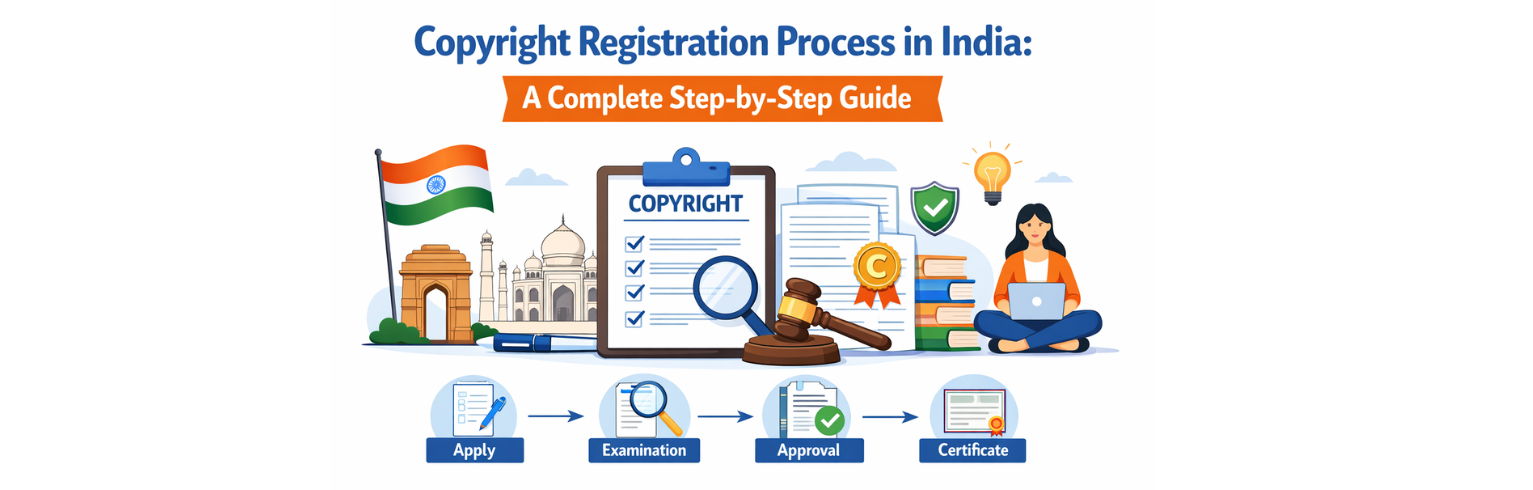
Also Read: Copyright Registration Process in India
Learn the copyright registration process in India, including documents, fees, eligibility, and benefits to protect your creative work legally.
Read Full Article →Documents Required for Copyright Registration in India
Having the right legal documents ready before you start the application will save you significant time:
For All Applicants:
- Completed Form XIV (filled online through the portal)
- Copy of the original work in digital format (PDF, MP3, image file, source code, etc.)
- Aadhaar Card or PAN Card of the applicant (identity proof)
- Address proof of the applicant or organization
- Power of Attorney (if applying through an authorized representative or agent)
- No Objection Certificate (NOC) from the publisher if the work is already published
Additional Documents for Specific Work Types:
- Software / Computer Programs: Source code with covering letter; may redact proprietary sections
- Films / Sound Recordings: Details of all creators involved — director, producer, lyricist, composer
- Artistic Works: High-resolution image of the artwork or design
- Published Books: Two copies of the published edition
Copyright Registration Fee in India 2026 — Complete Fee Structure
One of the most attractive aspects of copyright registration in India is how affordable the government fees are. Here's the transparent breakdown:
| Type of Work | Govt. Fee (Per Work) | Professional Fee (Optional) |
|---|---|---|
| Literary / Dramatic / Musical / Artistic | ₹500 | ₹3,000–₹10,000 |
| Computer Software / Programs | ₹500 | ₹5,000–₹15,000 |
| Cinematograph Films | ₹5,000 | ₹10,000–₹25,000 |
| Sound Recordings | ₹2,000 | ₹5,000–₹12,000 |
| Website Content (Literary) | ₹500 per work | ₹3,000–₹8,000 |
Government fees are highly reasonable — most creators pay just ₹500 per work. Professional or consultant fees are optional but recommended for businesses, software companies, and film producers where the documentation is more complex.
Expert Insight: In real-world scenarios, copyright applicants who use professional assistance see significantly fewer rejection letters and discrepancies from the Copyright Office. For high-value creative assets — software, films, or music albums — professional filing is almost always worth the additional cost.
Common Mistakes to Avoid When Applying for Copyright Registration in India
Experts who regularly handle copyright filings across India consistently flag these errors that delay or complicate the registration process:
Mistake #1 — Registering an Idea Instead of the Expression
Many first-time applicants try to register a concept, plot idea, or business strategy. Copyright law in India protects only the fixed, original expression of an idea — not the idea itself. Ensure your submitted work is a fully developed, original creation.
Mistake #2 — Submitting Low-Quality or Incomplete Work Copies
Uploading a blurry scan, an incomplete manuscript, or a partial source code file is one of the most common reasons for discrepancy letters. Always submit a complete, high-quality digital copy of your work.
Mistake #3 — Confusing Copyright with Trademark
Business owners frequently confuse the two. Copyright protects original creative works (books, music, software, art). Trademark protects brand identifiers (business names, logos, slogans). A logo, for example, can be protected under both — but through separate applications.
Mistake #4 — Not Mentioning All Co-Authors or Collaborators
If a work has multiple creators — for example, a song with separate lyricist and composer — all creators must be named in the copyright application. Omitting a co-author creates legal complications and can invalidate the registration.
Mistake #5 — Ignoring the 30-Day Objection Window
During the waiting period, third parties can raise objections. While most applications receive none, creators should monitor their diary number status. If an objection is raised, you need to respond formally — ignoring it can result in rejection.
Pro Tip: Keep all evidence of the creation process — drafts, design files, commit logs for software, email threads — even after your copyright is registered. In a dispute, showing a timeline of how your work was created is often as powerful as the certificate itself.
Copyright Registration in India — City-Wise Context for 2026
Copyright registration in India is processed centrally through the Copyright Office located in New Delhi, under the DPIIT. However, as of , the whole process is online — meaning creators in Mumbai, Bangalore, Chennai, Hyderabad, Pune, Kolkata, and every corner of India can apply without visiting any office.
Here's how copyright registration is being progressively used across India's creative and tech hubs:
- Delhi & NCR: Government departments, publishers, and content agencies are among the highest copyright filers
- Mumbai: India's entertainment capital — Bollywood films, music labels, and OTT production houses file extensively
- Bangalore: Software companies, SaaS startups, and app developers file source code copyright registrations regularly
- Chennai & Hyderabad: Regional film industries and gaming studios are major copyright applicants
- Pune: EdTech companies and e-learning content creators are piece by piece protecting course materials
However, in your city or state, the copyright registration process, fees, and timelines are matching across India — making it one of the most accessible IP protection mechanisms available.
Frequently Asked Questions — Copyright Registration in India 2026
Q1: Is copyright registration mandatory in India?
No, copyright registration is not mandatory in India. Copyright protection is automatic a top of creation of an original work under the Copyright Act, 1957. However, copyright registration provides a legal certificate of ownership that is necessary for enforcement, licensing, and dispute resolution in court.
Q2: How long does copyright registration take in India?
Copyright registration in India typically in between 2 to 6 months from the date of application. This includes the mandatory 30-day holding-of period after submission, followed by examination by the Copyright Office. Applications with complete documents and no objections are processed faster.
Q3: What is the fee for copyright registration in India?
The government fee for copyright registration in India is ₹500 for literary, dramatic, musical, artistic works and software. Sound recordings cost ₹2,000 and films cost ₹5,000 per application. Professional consultant fees are additional and optional, ranging from ₹3,000 to ₹25,000.
Q4: Can I register copyright for my website or blog in India?
Yes. Website content, blog articles, and original web copy are classified as literary works under the Copyright Act, 1957, and can be registered with the Indian Copyright Office. Each article or page is a separate work. The registration fee is ₹500 per literary work.
Q5: Can software be registered for copyright in India?
Yes. Computer programs and software source code are protected as literary works under the Copyright Act, 1957. Software copyright registration in India costs ₹500 per application. You may redact proprietary or sensitive portions of the source code when submitting to the Copyright Office.
Q6: What is the validity of copyright registration in India?
Copyright protection in India lasts for the lifetime of the author plus 60 years after their death for most works. For anonymous works, films, and sound recordings, it is 60 years from the year of publication. There is no concept of renewal — copyright expires naturally.
Q7: Can I apply for copyright registration online in India?
Yes. Copyright registration applications in India are submitted entirely online through copyright.gov.in, the official portal of the Copyright Office under DPIIT. No physical visit to the Copyright Office is required. Documents are uploaded digitally and fees are paid online.
Copyright vs Trademark vs Patent — Quick Comparison for Indian Creators
| Feature | Copyright | Trademark | Patent |
|---|---|---|---|
| What it Protects | Original creative works | Brand names, logos, slogans | New inventions & innovations |
| Governing Law | Copyright Act, 1957 | Trade Marks Act, 1999 | Patents Act, 1970 |
| Registration Body | Copyright Office, DPIIT | Trade Marks Registry | Patent Office, DPIIT |
| Govt Fee | ₹500–₹5,000 | ₹4,500–₹9,000 | ₹1,600–₹8,000+ |
| Protection Period | Life + 60 years | 10 years (renewable) | 20 years |
| Mandatory? | No (auto-protection) | No (but recommended) | No (voluntary) |
| Processing Time | 2–6 months | 18–24 months | 2–5 years |
Conclusion — Your Creative Work Deserves Legal Protection
Applying for copyright registration in India in is more approachable than ever — fully online, affordable, and straightforward when you follow the right process. Whenever you're a solo creator or a growing business, your original work has real value — and that value deserves protection.
The government fee starts at just ₹500. The process is completely online. And the legal protection it provides can save you years of disputes, losses, and frustration down the line.
Don't wait until someone copies your work to wish you had registered it. The best time to apply for Copyright Registration in India is right now — before your work goes public.
Need help with copyright registration in India?
Our intellectual property experts handle the entire process — from form filling and document preparation to submission and follow-up — ensuring your creative work is protected quickly, correctly, and completely.
©️ Apply for Copyright Registration in India Today — Fast, Expert-Guided & 100% Online!