Agmark Registration in India
Sell your agricultural products with confidence. Get your AGMARK certification done quickly, correctly, and without the paperwork headache.
Get in to Touch
Agmark Registration in India
If you deal in agricultural or allied products in India, you have probably come across the term AGMARK. Whether you are a farmer, a food processor, a cooperative society, or a trading firm, understanding what AGMARK certification means—and how to get it—can make a real difference to your business.
This page walks you through everything: what AGMARK is, why it matters, which products need it, the documents required, the step-by-step registration process, costs involved, and how our AGMARK registration services can make the whole journey smoother for you.
What is Agmark Registration?
AGMARK stands for Agricultural Marketing. It is a quality certification mark issued by the Directorate of Marketing and Inspection (DMI), which operates under the Ministry of Agriculture and Farmers' Welfare, Government of India. When a product carries the AGMARK label, it means it has been tested, graded, and certified to meet standards laid down by the government.
The legal backbone of AGMARK is the Agricultural Produce (Grading and Marking) Act, 1937. Under this Act, the government sets grade standards for agricultural commodities, and producers or manufacturers who want to use the AGMARK logo must obtain a valid AGMARK licence from the DMI.
Think of it this way: AGMARK is India's promise to the consumer that the product on the shelf — whether it is ghee, turmeric, or groundnut oil — is exactly what it claims to be, in the right grade and quality. For the producer, it is a mark of credibility that opens doors to premium markets, government procurement, and export channels.
Why You Need AGMARK Registration
You might wonder whether AGMARK is really necessary for your business. Here is an honest answer: for certain product categories it is legally required, and for others, it is a powerful competitive advantage.
Legal compliance: For products like ghee, edible oils, and certain spices, selling without AGMARK certification can attract penalties under the 1937 Act.
- Consumer trust
- Access to government procurement
- Better market pricing
- Export opportunities
- Brand differentiation
Products Covered Under AGMARK Certification
AGMARK certification covers a wide range of agricultural commodities and processed food products. The DMI has established grading standards for more than 220 commodities. Below are the major categories covered under the AGMARK online registration framework:
Edible oils and fats:
Groundnut oil, mustard oil, coconut oil, sesame oil, sunflower oil, and blended edible vegetable oils.
Dairy products:
Ghee (one of the most commonly AGMARK-certified products), butter, cheddar cheese, and skimmed milk powder.
Spices and condiments:
Turmeric, chilli powder, coriander, cumin, pepper, and blended spice powders.
Cereals, pulses and grain products:
Wheat flour (atta), rice, gram flour (besan), and pulses.
Honey:
Pure honey is one of the flagship AGMARK-certified products, with strict standards for moisture, sugar composition, and purity.
Fruits and vegetables:
Fresh produce like potatoes, onions, and certain fruits also fall under AGMARK grading standards.
Miscellaneous:
Vermicelli, macaroni, wheat products, cattle feed, and several other processed agricultural items.
Documents Required for AGMARK Registration
One of the most common pain points applicants face is incomplete documentation. Getting your documents in order before you apply for AGMARK online registration will save you significant time. Here is a comprehensive list of what you will typically need:
Business & Identity Documents
- ● Certificate of incorporation or partnership deed or proprietorship declaration
- ● PAN card of the business entity
- ● GST registration certificate
- ● Address proof of the manufacturing unit (electricity bill, rent agreement, or property documents)
- ● Identity proof of proprietor, partners, or directors (Aadhaar, passport, or voter ID)
- ● Passport-size photographs of the applicant
Manufacturing & Technical Documents
- ● Details of the manufacturing process and facility layout
- ● List of machinery and equipment used in production
- ● Details of in-house laboratory facilities (if available)
- ● Sample product label showing product name, grade, net weight, and manufacturer details
- ● FSSAI licence (required for food products)
Financial Documents
- ● Bank account details and cancelled cheque
- ● DD or online payment receipt for AGMARK registration fees
- ● Audited balance sheet (for companies with an established track record)
Document requirements can vary slightly based on the product type and state. Our AGMARK registration consultant will give you a precise checklist tailored to your commodity and business structure.
Step-by-Step Process of AGMARK Registration
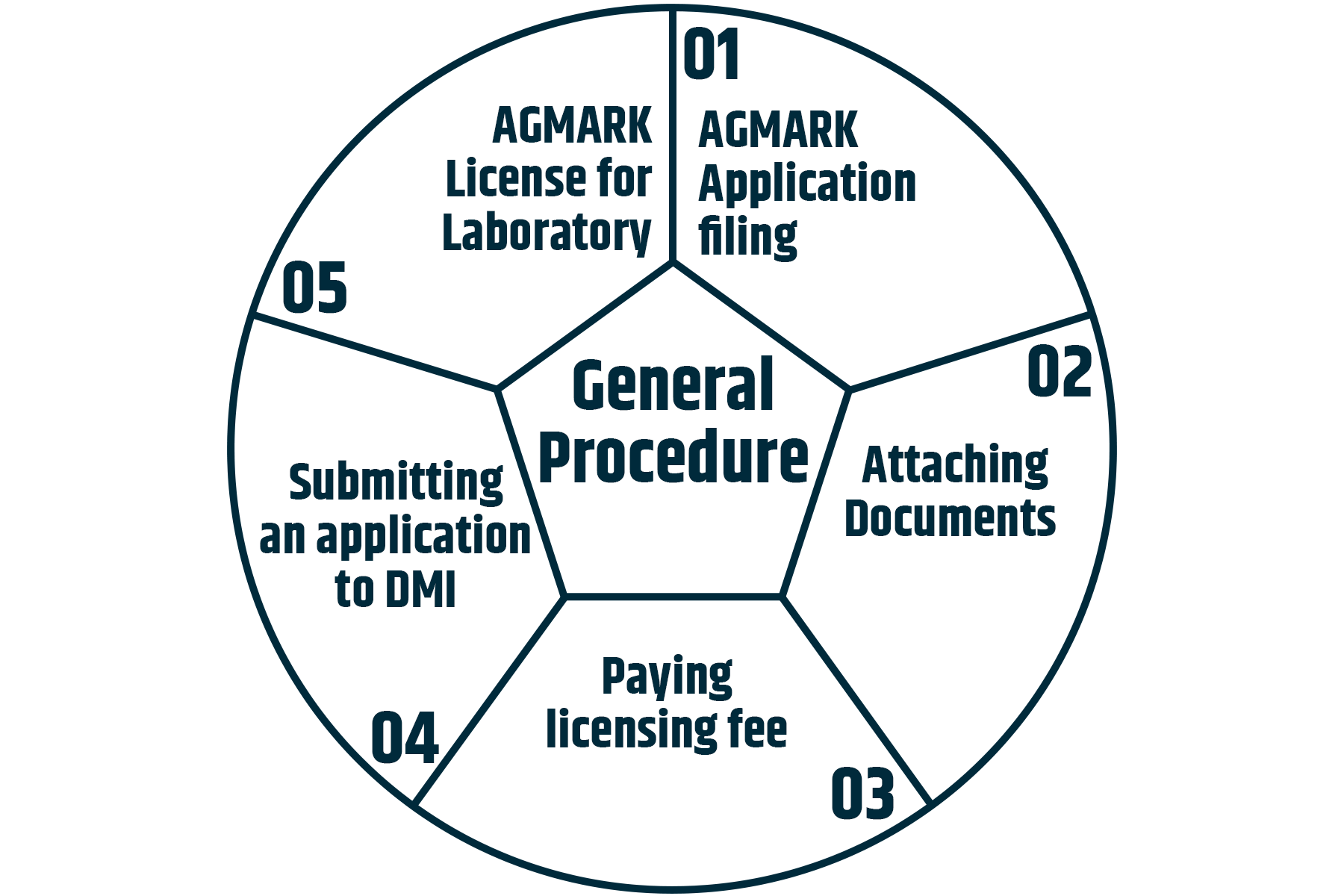
The AGMARK Registration Process involves several stages, but it is manageable if you know what to expect. Here is a clear breakdown of how it works:
Application on the AGMARK Portal: The process begins at agmarknet.gov.in , the government's official online portal. You will need to create a login, select your product category, and fill in the application form accurately. This is where agmark online registration begins.
Document Submission: Once the form is filled, you upload all the required documents. Errors or missing documents at this stage are the number one reason for delays, so it is worth double-checking everything.
Payment of Fees: You pay the AGMARK registration fees online through the portal. The AGMARK registration cost varies depending on the product category and the grade standards applicable. We explain fee structures in detail when you consult with us.
Scrutiny by DMI Officials: The Directorate of Marketing and Inspection reviews your application, documents, and the details of your manufacturing unit. They may request additional information or clarification at this stage.
Inspection of the Manufacturing Unit: A DMI inspector will visit your facility to verify that your production setup, hygiene standards, storage conditions, and quality control measures meet the required norms.
Sample Testing: Product samples are collected and sent to a recognised laboratory for testing. The samples are tested against AGMARK grade specifications for the relevant commodity.
Grant of AGMARK Licence: If the inspection report and lab test results are satisfactory, the DMI issues the AGMARK licence. You can then legally use the AGMARK logo on your product packaging.
Ongoing Compliance: AGMARK certification is not a one-time formality. Regular surprise inspections and periodic sample testing are part of the programme to ensure you maintain quality standards consistently.
Benefits of AGMARK Certification
Beyond legal compliance, AGMARK certification delivers real, tangible business benefits. Here is what certified businesses typically experience:
Stronger consumer confidence:
The AGMARK logo reassures buyers that the product is genuine, properly graded, and safe to use. This translates directly into repeat purchases and brand loyalty.
Eligibility for export:
Many overseas markets, particularly in the Middle East, Southeast Asia, and parts of Europe, prefer or require AGMARK certification for Indian agricultural exports.
Access to institutional buyers:
Government departments, the Food Corporation of India (FCI), the National Cooperative Exports Limited (NCEL), and large food companies prefer AGMARK-certified suppliers.
Better shelf placement in retail:
Modern retail chains — including hypermarkets and e-commerce platforms — often prioritise or exclusively stock AGMARK- certified products in categories like ghee, honey, and edible oils.
Reduced adulteration risk:
Because your product undergoes periodic testing, AGMARK certification acts as a quality management discipline that minimises adulteration and production inconsistencies within your own operation.
Legal protection:
In the event of a consumer complaint or market dispute, having an active AGMARK licence demonstrates your commitment to quality and protects you legally.
Who Can Apply for AGMARK Registration
AGMARK registration is open to a wide range of business structures. Eligibility is not limited to large corporations — many small and medium-scale producers across India hold valid AGMARK licences. The following entities can apply:
Individual farmers and producers who process and package their own agricultural produce
Sole proprietorships, partnership firms , and LLPs engaged in agricultural commodity processing
Private and public limited companies manufacturing agri-food products
Cooperative societies and farmer producer organisations (FPOs)
Self-help groups (SHGs) involved in small-scale food production
Exporters and trading houses dealing in agricultural commodities
The key requirement is not the size of your business — it is the quality of your product and your production setup. As long as you can meet AGMARK grade standards and maintain a compliant manufacturing environment, you are eligible to apply.
Our AGMARK Registration Services
Agmark registration in india can be be time-consuming, especially if you are running a business simultaneously. That is where our AGMARK registration services come in. We are a team of experienced compliance consultants who have helped hundreds of food and agri-product businesses get certified.
Here is what we offer:
Free eligibility assessment:
We review your product, business structure, and existing certifications to confirm whether AGMARK applies to you and what grade standards you need to meet.
Document preparation and verification:
Our team prepares and reviews all documentation before submission, ensuring nothing is missing or incorrectly filed.
End-to-end agmark online registration:
We handle the entire application on the government portal on your behalf, from account creation to final submission.
Inspection readiness support:
We prepare you thoroughly for the DMI factory inspection, advising on what the inspector will look for and how to ensure your facility meets requirements.
Liaison with DMI officials:
If the department requests clarifications or additional documents, we handle the correspondence on your behalf, minimising delays.
Transparent fee breakdown:
We clearly explain the AGMARK registration fees payable to the government and our service charges upfront — no hidden costs.
Post-licence support:
Once you receive your AGMARK licence, we help you with labelling compliance, record-keeping requirements, and timely renewal reminders.
Validity & Renewal of Agmark Registration
AGMARK licence is typically valid for one year from the date of issue. After this period, it must be renewed to continue using the AGMARK label on your products. Some categories may be granted multi-year licences based on the product type and the applicant's compliance track record.
Renewal Process
The renewal of an AGMARK licence follows a process similar to fresh registration, but it is generally faster if you have maintained compliance. Here is what to expect:
Renewal application should be submitted at least 30 to 60 days before the licence expiry date to avoid any gap in certification.
Updated documents (such as a renewed FSSAI licence, updated address proof, or revised label) must be submitted along with the renewal application.
Renewal fees are paid online through the AGMARK portal.
A fresh inspection of the unit may or may not be conducted depending on the inspector's assessment of your previous compliance record.
Frequently Asked Questions (FAQs)
Q: Is AGMARK certification mandatory for all food products?
No, AGMARK certification is not mandatory for every food product in India. It is compulsory for specific commodities notified under the Agricultural Produce (Grading and Marking) Act, 1937 — the most notable example being pure ghee. For other products, AGMARK certification is voluntary but highly recommended, particularly if you intend to sell through organised retail, institutional buyers, or export channels. If you are unsure whether your product requires mandatory certification, consult with an AGMARK registration consultant.
Q: How long does it take to get an AGMARK licence?
The timeline for obtaining an AGMARK licence typically ranges from 30 to 90 days from the date of complete application submission. The variation depends on the product type, the responsiveness of the concerned DMI regional office, scheduling of the factory inspection, and the turnaround time of the laboratory testing. Delays most often occur due to incomplete documentation or facility readiness issues. Working with an experienced AGMARK registration consultant can help avoid these bottlenecks and speed up the process considerably.
Q: Can small-scale units apply for AGMARK?
Yes, absolutely. Small-scale producers, cottage industry units, self-help groups, and individual entrepreneurs can all apply for AGMARK registration. There is no minimum production capacity or turnover requirement. What matters is that your manufacturing unit meets the basic hygiene, storage, and quality control standards specified by the DMI for your product category. In fact, AGMARK certification is a particularly powerful tool for small producers because it helps them compete with established brands on the basis of verified quality.
Q: Is AGMARK recognised internationally?
AGMARK is a domestic certification under Indian law and is not equivalent to international quality standards like ISO or CODEX. However, it is widely recognised and respected by importers in markets that regularly import Indian agricultural products — especially in South Asia, the Middle East, and parts of Africa and Southeast Asia. Many international buyers view AGMARK certification as a reliable indicator of consistent quality and authenticity, which makes it a useful credential when entering new export markets. For exporting to markets with stricter requirements, AGMARK certification is often a useful first step alongside other standards like APEDA certification or FSSAI export registration.
Enquiry Now
Register Your Agmark Registration Today.