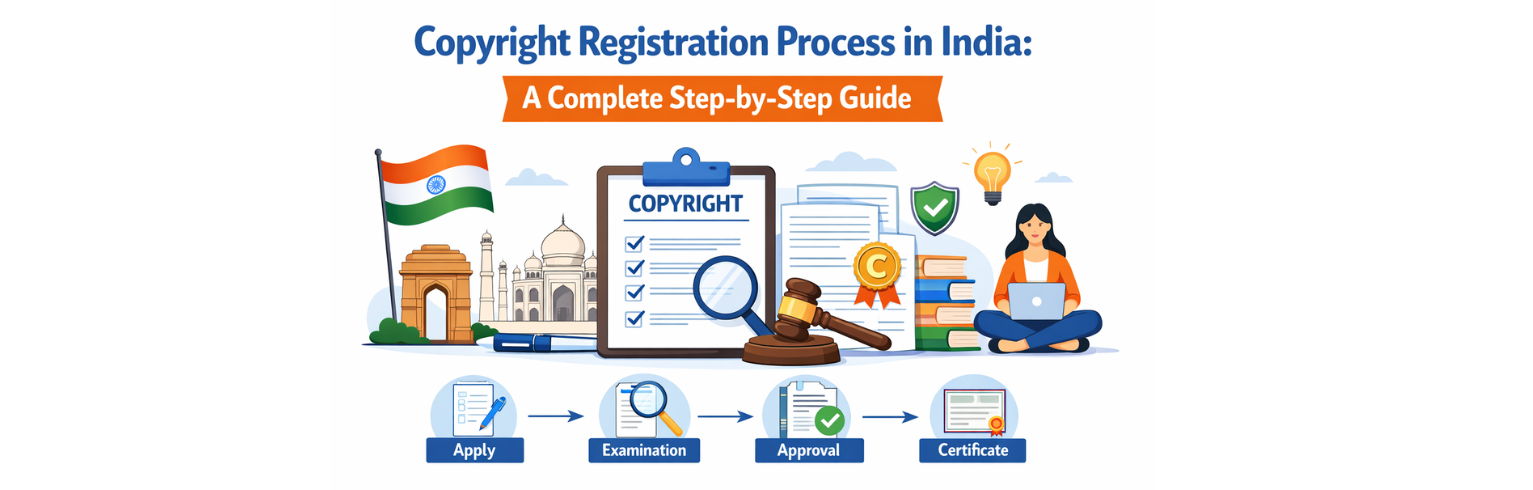
Copyright Registration Process in India: A Complete Step-by-Step Guide
In today's content-driven and digital world, protection of intellectual property has become more essential than ever before. Musicians, writers and filmmakers, as well as photographers, software developers and other designers put a lot of time and effort into their work. Copyright law guarantees that creators retain the legal right to own and control the way their work is used.
In India, copyright protection in India is controlled through the Copyright Act, 1957, which grants the creator legal protection for their original work. While copyright protection is automatic when a work is first created, registering the copyright is a strong legal proof for ownership and makes it easier to enforce in the event of disputes.
This blog will explain what is involved in the Copyright Registration process in India and explain Step-by-Step Guide other advantages.
What is Copyright?
Copyright is a kind of protection for intellectual property granted to the authors who have created original work. It grants the creator complete rights to reproduce, copy the work, distribute, publish, and perform their work.
The rights granted ensure that others are not able to copy or use this work without authorisation.
In India, copyright protection is only for the expression and dissemination of ideas and not the idea itself.
Types of Works Protected Under Copyright in India
Copyright law covers a wide variety of artistic works. This includes:
1. Literary Works
This category also includes written content, such as:
- Books
- Blog posts and articles
- Poetry
- Software and computer programs
- Databases
2. Artistic Works
They include visual works, including:
- Paintings
- Drawings
- Sculptures
- Photographs
- Logos and graphics
3. Musical Works
The music compositions include:
- Original music
- Background scores
- Notes and arrangements
4. Cinematograph Films
Documentaries, movies and video content are included in this category.
5. Sound Recordings
Audio recordings like:
- Songs
- Podcasts
- Audiobooks
- Speeches recorded
Why is Copyright Registration Important?
Although protection for copyrights is automatically granted once the work has been published, registration provides legal advantages.
1. Legal Evidence of Ownership
A copyright certificate is official proof of ownership in court.
2. Public Record of Ownership
The registration creates an open record that reveals who is the owner of the work.
3. Protection Against Infringement
The owner can pursue legal action if anyone copies or uses the work in a way that is not permitted by the owner.
4. Licensing and Commercial Use
The registration of copyrights makes it easier for you to sell, license, or commercially make use of the work.
5. Financial Benefits
Creators can earn royalties from licensing agreements.
Who Can Apply for Copyright Registration?
The following persons or entities may be eligible:
- The person who wrote or created the work
- The Copyright owner
- A legal representative or agent
- An organisation or a company that owns the work
If the piece has more than one writer, all authors must be listed in the submission.
Documents Required for Copyright Registration
Before submitting an application before submitting the application, the following documents should be completed:
- The copy of the piece (manuscript file, musical file, artwork, etc.)
- Identity document and proof of address for the applicant
- NoC (No Opinion Certificate) from the author if the applicant is not the same
- Power of Attorney. It is filed through an advocate
- Information about publication (if your work was published previously)
- NoC from the publisher if it is relevant
To protect the copyright of software, other items like objects and source codes might also be required.
Step-by-Step Copyright Registration Process in India
The registration of copyrights in India is managed through the Copyright Office within the Ministry of Commerce and Industry. The application can be made on the internet or offline.
Below is the step-by-step procedure.
Step 1: Create an Account on the Copyright Portal
The applicants must sign up with the copyright portal and then create an account as a user.
After login, users are able to access their copyright registration form (Form XIV).
Step 2: Fill the Application Form
The applicant should fill out the registration form for copyrights by providing information such as:
- Address and name of the applicant's address and name
- The nature of the work
- The title of the work
- Language used in the piece
- Name and contact information of the Author's name and contact information
- Publication details
The accuracy of the information you fill in the application form, since incorrect data could delay registration.
Step 3: Pay the Government Fee
Once the form is submitted and submitting the form, the applicant is required to pay the stipulated government fee, and this fee varies based on the nature of work.
Examples include:
- Literary works
- Artistic works
- Musical works
- Software programs
It is possible to pay via online bank accounts, credit cards, and debit cards.
Step 4: Submit Copies of the Work
The applicant is required to provide proof of work that is being registered.
For instance:
- Literary works, manuscripts and manuscripts
- Artwork or images for artistic work
- Audio files for musical compositions
- Software source code
They are part of the copyright official document.
Step 5: Diary Number Issued
When the application has been completed and approved, the copyright office will issue a diary number.
It is utilised to keep track of the status of applications.
Step 6: Mandatory Waiting Period
Once you have received an entry in the diary, there's a 30-day time period for waiting.
At this point:
- Any objections may be made through third-party sources.
- The copyright office reviews the application.
Step 7: Examination by the Copyright Office
If there are no objections, if no objections are filed, the application is referred for review.
If objections are brought up in the meantime, it is possible that the Registrar of Copyrights can organise a hearing to settle the matter.
Step 8: Issuance of Copyright Certificate
If the application is able to pass the examination stage with flying colours, and if the application is successful, the Copyright Office issues the Certificate of Registration. Certificate.
The copyright then becomes legally recorded and registered in the Register of Copyrights.
Time Required for Copyright Registration
The entire registration process for copyrights in India typically takes about 2 to 4 months, according to:
- The accuracy of the application
- The presence of objections
- The verification process is carried out by the Copyright Office
If there are objections raised or raised, the process could be delayed.
Government Fees for Copyright Registration
The fee charged by the government is contingent on the kind of work declared.
The most common categories include:
- Literary works
- Artistic work
- Musical work
- Cinematograph film
- Software
The fees can change regularly, so applicants must verify the latest fee structure available on the official website.
Duration of Copyright Protection in India
Copyright protection lasts for a long period.
For most works:
Time of life for the creator + 60 years following the death of the author.
Other works, like recordings of sound, film images, and even government work:
60 years after the publication date
Copyright Infringement and Legal Remedies
Copyright Infringement violations occur when a person copies copyrighted content without authorisation.
Examples include:
- Copying material from blogs or books
- Utilising images with copyrights without authorisation
- Making copies of music or videos in violation of the law
Legal remedies available include:
- Injunctions to stop the use of unauthorised substances
- Damages to the economy
- Possession of copyrighted copies
- Criminal punishments in grave instances
Tips for Smooth Copyright Registration
To be sure that they don't get delayed, applicants must be sure to follow these guidelines:
- Verify that the work must be unique and original.
- Complete the application form with care.
- Send proofs of your work in a clear copy.
- Attach all documents required.
- Make sure to keep the diary number safe to track.
- Legal assistance from a professional can assist in an easier registration.
Conclusion
Copyright registration plays an essential part in securing the creative work of artists, authors, developers, and other creatives from India. Although copyright protection is available automatically, registration of the copyright can provide legal protection and recognition of ownership by the public, and a simpler way to enforce rights.
The process is quite simple. You simply need to submit your application along with the required government fee, sit for the mandatory objection period, and then receive the certificate after approval.
For businesses and individuals who depend on the creation of content, copyright registration is an essential step to safeguard intellectual property rights and prevent unauthorised use.
If they are aware of the process for registering copyrights by understanding the process of registering copyrights in India, creators can confidently secure their work and profit from their talents for years to come.
Frequently Asked Questions (FAQs) for the Copyright Registration Process
1. What is copyright registration?
Copyright registration is a legal process that grants the creator all types of exclusive rights over their original work, such as literary, artistic, musical, or software content, protecting it from unauthorised use or reproduction.
2. Why is copyright registration important?
It provides all legal proof of ownership, helps prevent infringement, and allows the owner to take legal action against unauthorised use or copying of their work.
3. Who can apply for copyright registration?
Any creator, author, artist, producer, or owner of an original work can apply. This includes individuals, companies, and organisations.
4. What types of works can be registered under copyright?
Copyright protection applies to:
- Literary works (books, blogs, articles)
- Artistic works (paintings, logos, designs)
- Musical works
- Cinematographic films
- Sound recordings
- Computer software and programs
5. How can I apply for copyright registration in India?
You can apply online through the official Copyright Office portal or with the help of a legal professional by submitting the application form, required documents, and fees.
6. What documents are required for copyright registration?
Common documents include:
- Copy of the original work
- Applicant's identity proof
- No Objection Certificate (if applicable)
- Power of Attorney (if filed through an agent)
7. How long does it take to get copyright registration?
Copyright Registration takes around 2 to 6 months, depending on objections or discrepancies during the examination process.
8. What is the validity of copyright in India?
The validity generally lasts for the lifetime of the author plus 60 years after their death.
9. What are the government fees for copyright registration?
Fees vary depending on the type of work but usually start from a few hundred rupees per application.
10. Can copyright be transferred or assigned?
Yes, copyright can be assigned, licensed, or transferred to another party through a written agreement.
11. What is copyright infringement?
Copyright Infringement occurs when someone uses, reproduces, or distributes copyrighted work without permission from the owner.
12. What legal action can be taken against copyright infringement?
The owner can file a legal case, claim damages, and seek injunctions to stop unauthorised use of their work.
13. Is copyright registration mandatory in India?
No, copyright protection is automatic upon creation. However, registration is recommended as it serves as legal evidence in court.
14. Can I register copyright for my website content?
Yes, website content, including text, images, graphics, and code, can be registered under copyright protection.
15. Can software and mobile apps be copyrighted?
Yes, software, source code, and mobile applications are protected as literary works under copyright law.