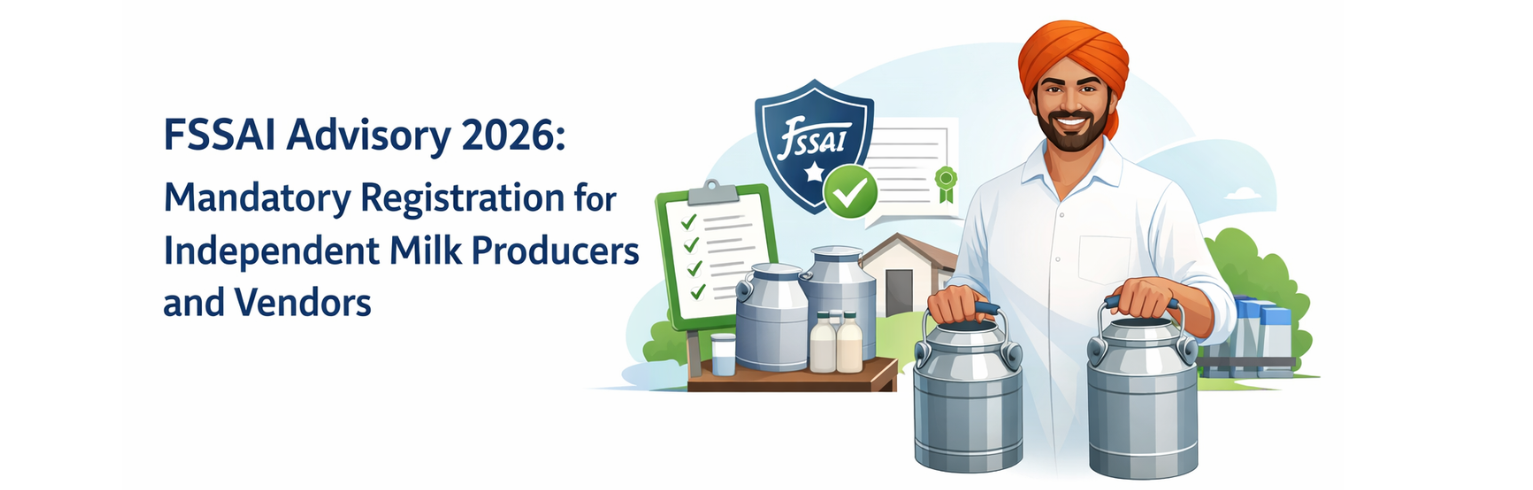
FSSAI Advisory 2026: Mandatory Registration for Independent Milk Producers and Vendors
Are You a Milk Vendor or Dairy Farmer Still Selling Without FSSAI Registration?
If yes, is the year you can no longer afford to ignore this. The Food Safety and Standards Authority of India (FSSAI) has issued a fresh advisory making FSSAI Registration for milk producers and independent milk vendors absolutely mandatory — no exceptions.
Whether you supply milk door-to-door in a small colony, run a dairy farm on the city's outskirts, or sell loose milk at a local market, this new directive applies directly to you. And the penalties for non-compliance are serious.
In this guide, we'll explain the FSSAI advisory in plain language — who it affects, what it costs, how to apply, and what happens if you don't comply. Let's break it all down, step by step.
What Is the FSSAI Advisory 2026?
The FSSAI Advisory is an official regulatory update issued by the Food Safety and Standards Authority of India, targeting a critical gap in India's food safety framework — the large number of independent milk producers and small-scale vendors operating without any food safety registration.
Milk is one of India's most consumed foods, and also one of the most frequently adulterated. The advisory aims to bring every player in the milk supply chain — from the farmer who produces it to the vendor who delivers it to your doorstep — under the FSSAI compliance umbrella.
In simple terms: if you produce, store, transport, or sell milk in any form — packaged or loose — you must now hold a valid FSSAI food license or registration. No registration means no legal right to operate.
Who Must Register Under the FSSAI 2026 Milk Advisory?
This advisory casts a wide net. If your business involves milk in any capacity, you are covered. Here's who specifically falls under this rule:
- Independent milk producers (dairy farmers selling directly to consumers or vendors)
- Local milk vendors supplying loose or packaged milk in residential areas
- Door-to-door milk delivery services
- Small dairy businesses — including cooperatives and micro-dairies
- Milk collection agents and aggregators
- Retailers selling milk, curd, paneer, or other dairy products
- Cloud-based or app-based milk delivery startups
Important: Even if you sell milk locally within a small neighbourhood or village, this rule applies to you. Scale does not exempt you from registration.
Why Is FSSAI Registration Now Mandatory for Milk Vendors?
India's dairy sector is massive — but it's also riddled with food safety risks. Milk adulteration (with water, detergent, urea, or synthetic compounds) has been a persistent problem. The advisory is FSSAI's strongest move yet to clean up the supply chain.
Here's why this advisory matters:
- Food Safety: Unregistered vendors are harder to inspect and hold accountable
- Consumer Protection: Buyers have a right to know their milk meets safety standards
- Traceability: FSSAI registration creates a verifiable record from farm to table
- Quality Assurance: Registered vendors must meet minimum hygiene and handling norms
- National Compliance Push: Aligns India's dairy sector with global food safety benchmarks
The advisory also reflects FSSAI's broader agenda — making India's food ecosystem safer, more transparent, and accountable from the ground up.
FSSAI Registration Charges for Milk Vendors and Dairy Businesses
One of the most common questions is: how much does FSSAI registration cost for a milk business? Here's a clear, honest breakdown:
| Cost Component | Estimated Range | Applicable For |
|---|---|---|
| Basic FSSAI Registration | ₹100/year | Turnover up to ₹12 Lakhs |
| State FSSAI License Fee | ₹2,000–₹5,000/year | Turnover ₹12L–₹20 Crores |
| Stamp Duty & Notary | ₹500–₹2,000 | Documentation formalities |
| Professional / Consultant Fee | ₹2,500–₹15,000 | Optional but recommended |
| PAN / TAN Registration | ₹150–₹500 | If not already registered |
Most small milk vendors and independent dairy farmers will qualify for Basic FSSAI Registration, which costs just ₹100 per year — a small price for full legal protection and consumer trust.
💬 Not Sure Which License You Need? Get a Free FSSAI Consultation for Your Dairy Business — Today!
Documents Required for FSSAI Registration
The documentation process is straightforward. Here's everything you'll need to keep ready:
For Basic Registration (Small Milk Vendors):
- Aadhaar Card or Voter ID (identity proof)
- Passport-size photograph of the business owner
- Business address proof (electricity bill / rent agreement)
- Details of food products handled (mention: raw milk, pasteurised milk, curd, etc.)
- Completed Form A from the FoSCoS portal
For State License (Medium-Scale Dairy Businesses):
- PAN Card of owner / business
- GST Registration Certificate (if applicable)
- List of dairy products manufactured or sold
- Layout / blueprint of dairy premises or processing area
- Milk source declaration (own farm or procurement details)
- NOC from local municipality / panchayat
- Business registration certificate (partnership deed / incorporation certificate)
Step-by-Step Process to Apply for FSSAI Registration as a Milk Producer
Here's how to get your FSSAI food license for dairy business — in 6 simple steps:
- Step 1 — Determine Your License Type: Basic (under ₹12L turnover) or State License (above ₹12L). Most small vendors need Basic.
- Step 2 — Gather Your Documents: Use the list above. Ensure all files are clear scans or PDFs.
- Step 3 — Visit the FoSCoS Portal: Go to foscos.fssai.gov.in and create your account using your mobile number and Aadhaar.
- Step 4 — Fill Form A (Basic) or Form B (State/Central): Enter your personal details, business address, and food category (select 'Milk and Milk Products').
- Step 5 — Upload Documents and Pay the Fee: Upload your files in the specified format and complete the online payment (₹100 for Basic).
- Step 6 — Receive Your Certificate: Your 14-digit FSSAI registration number will be issued digitally. Display it at your dairy premises and on packaging.
Pro Tip: First-time applicants often make errors on Form A or upload incorrect documents. Working with an FSSAI consultant saves time and prevents rejection.
Also Read: FSSAI Registration for Milk Products in India
Learn the FSSAI registration process for milk and milk products in India, including eligibility, required documents, licensing types, and compliance rules for dairy businesses.
Read Full Article →What Happens If You Don't Register? Penalties Are Severe.
Non-compliance with the FSSAI milk advisory is not something to take lightly. Here's what you risk:
- Fine up to ₹5 Lakh for operating a food business without FSSAI registration
- Imprisonment of up to 6 months for unlicensed food operations
- Business shutdown by food safety officers
- Seizure of milk stock and dairy equipment
- Fines exceeding ₹10 Lakh for selling unsafe, adulterated, or substandard milk
- Blacklisting from platforms like Swiggy, Blinkit, Zomato, and Amazon Fresh
Bottom line: The cost of non-registration far exceeds the cost of getting registered. Don't wait for a raid to act.
Benefits of FSSAI Registration for Milk Producers and Vendors
Beyond avoiding penalties, FSSAI registration genuinely grows your business:
- Legal Protection: Operate with full confidence — no risk of shutdown
- Consumer Trust: Customers actively prefer FSSAI-registered dairy suppliers
- Business Expansion: Required to sell on Swiggy, Dunzo, Blinkit, or your own app
- Bank Loans & Subsidies: FSSAI registration supports MUDRA loan and government scheme eligibility
- Government Recognition: Opens doors to dairy board tie-ups and cooperative schemes
- Brand Credibility: Your 14-digit FSSAI number signals quality and accountability
Frequently Asked Questions (FAQs) — FSSAI Registration for Milk Producers
(Optimized for Google AI Overview, Featured Snippets, and Voice Search)
Q1: Is FSSAI registration mandatory for milk vendors in 2026?
Yes. As per the FSSAI Advisory , all independent milk producers, local milk vendors, dairy farmers, and door-to-door suppliers must obtain FSSAI registration or a food license. Operating without it is a punishable offence with fines up to ₹5 Lakh.
Q2: What is the cost of FSSAI registration for a small dairy business?
For small milk vendors with an annual turnover under ₹12 Lakhs, the Basic FSSAI Registration costs just ₹100 per year. Professional consultant fees range from ₹2,500 to ₹15,000 for end-to-end support including documentation and filing.
Q3: Can small milk sellers apply for FSSAI registration online?
Yes. FSSAI registration is completely online through the FoSCoS portal at foscos.fssai.gov.in. Fill Form A, upload your documents, and pay ₹100 online. No physical visit to an FSSAI office is required for Basic Registration.
Q4: What is the penalty for not having an FSSAI license as a milk vendor?
The penalty for operating a dairy or milk business without FSSAI registration includes fines up to ₹5 Lakh and up to 6 months of imprisonment. For adulteration or selling unsafe milk, the fine can exceed ₹10 Lakh. Repeat violations lead to permanent business closure.
Q5: How long does FSSAI registration take for milk producers?
Basic FSSAI Registration for milk vendors typically takes 7–10 working days after submitting a complete application on the FoSCoS portal. State License processing takes 15–20 days. With professional help, approvals can be faster due to error-free applications.
Q6: Do dairy farmers need FSSAI if they only sell raw milk locally?
Yes. Even farmers selling raw milk directly to consumers or local vendors are covered under the FSSAI advisory. The only exemption is for farmers selling milk exclusively to their own household — all commercial sales require registration.
Q7: What food category should milk vendors select on the FSSAI portal?
Milk vendors and dairy businesses should select 'Milk and Milk Products' as their food category during FSSAI registration. This covers raw milk, pasteurised milk, curd, paneer, ghee, butter, and other dairy derivatives.
Transparent Expert Advice: What FSSAI Consultants Want You to Know
If you've been procrastinating on FSSAI registration because it seemed complicated or expensive, here's the truth from compliance professionals who handle dairy registrations every day:
- The process is genuinely simple for small vendors — most Basic registrations are done in under 2 hours with the right guidance
- ₹100/year is one of the lowest government compliance fees in India — there's no financial excuse
- The advisory is being actively enforced — food safety officers are increasing inspections in urban and peri-urban dairy supply chains
- Registered vendors are gaining a competitive edge — consumers and retailers are increasingly asking for the FSSAI number before buying
- FSSAI registration is just the first step — 12A, 80G, and GST compliance may follow as your dairy business scales
Disclaimer: Registration timelines and fees are subject to change based on state regulations and FSSAI portal updates. Always consult a certified FSSAI compliance professional for accurate, state-specific guidance.
Get Your FSSAI Registration for Milk Business — Start Today!
The FSSAI advisory is clear: registration is no longer optional for milk producers and vendors. Every day you delay is a day you risk fines, inspection, or shutdown.
Here's what to do right now:
- Get a free consultation with a certified FSSAI consultant
- Know your exact registration type and fee in 10 minutes
- Apply with complete professional support — error-free, fast approval
- Receive your FSSAI certificate and operate with full legal confidence
Your Dairy Business — Free Consultation, Fast Registration, 100% Compliant!